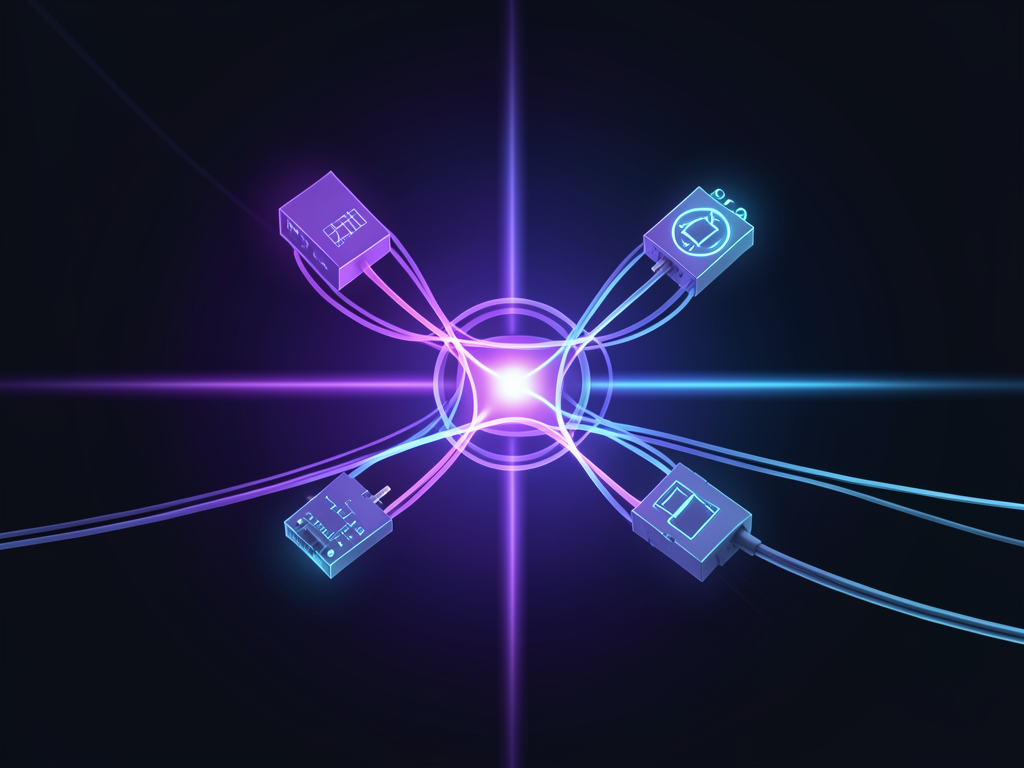
Cisco quantum switch points to networked scale
Cisco's new quantum switch preserved entanglement with at most 4% fidelity loss, a useful sign that interoperability may matter as much as qubit count.
Quantum computing news today is really networking news.
Cisco has introduced a universal quantum switch prototype that routes entangled photon signals across different encoding formats, with proof-of-concept tests showing less than or equal to 4% degradation in quantum state fidelity and entanglement. That matters because useful quantum systems are unlikely to scale as one giant machine. They are more likely to scale as networks of smaller systems, sensors, and classical control layers that can actually talk to each other.
For anyone tracking quantum computing in 2026, this is the more interesting question: not just how many qubits a vendor can build, but whether those systems can interoperate over infrastructure that already exists.
What Cisco actually announced
According to Cisco’s press release, the prototype is designed to accept quantum information in one encoding format, convert it into a common internal representation for routing, and then output it in the format a receiving device expects.
That sounds abstract, but the problem is real. Different quantum systems use different ways to encode information in photons, including polarization, time-bin, frequency-bin, and path encoding. If those systems cannot exchange quantum information without destroying it, vendor-neutral quantum networking stays stuck as a research slogan.
Cisco says the switch operates at room temperature, over standard telecom fiber, and can reconfigure connections in as little as 1 nanosecond. Those details matter more than the branding. A lab-only networking demo is one thing. A design built around existing fiber and data center conditions is much closer to something enterprises can evaluate.
If you want background on why entanglement is the key resource here, see our explainer on what entanglement is and what it is not.
Why this matters for quantum computing
The most important part of this story is not the switch itself. It is the systems argument behind it.
Quantum hardware roadmaps still talk about qubits in the hundreds or low thousands. But useful fault-tolerant applications are widely expected to need far more. Cisco’s pitch is that the industry may bridge that gap partly by connecting smaller quantum systems together rather than waiting for a single monolithic machine to do everything.
That framing fits a broader industry shift we covered in The quantum industry just stopped counting qubits. The field is slowly moving from isolated processor milestones to infrastructure questions:
- How do different quantum devices interoperate?
- How do you share expensive resources like entanglement sources and detectors?
- How do you integrate quantum hardware into existing fiber and data center environments?
- How much classical networking and control overhead appears once systems are distributed?
Those are not glamorous questions. They are also the questions that decide whether quantum computing becomes deployable infrastructure or stays a collection of isolated demos.
The limitations are the real story too
Cisco’s announcement is interesting, but it is still an early prototype.
Three caveats matter.
First, the strongest published performance number is still limited: less than or equal to 4% degradation in encoding and entanglement fidelity. That is encouraging, but it is not the same as a full end-to-end benchmark for a useful distributed quantum workload.
Second, Cisco says the switch is designed to support the major encoding modalities, but the company also says it has been experimentally validated with polarization encoding so far. Support for time-bin and frequency-bin is built into the design, but validation is still the next step.
Third, there is no claim here of commercial quantum networking at scale. This is a research prototype. The hard problems still include long-distance loss, synchronization, error handling across distributed systems, and proving that the networked approach beats simpler alternatives for real tasks.
That honest framing is important. Quantum networking often gets described with internet-scale analogies long before the engineering deserves it. Here, the right read is narrower: Cisco has built a credible hardware building block for interoperability, not a finished quantum internet.
What CTOs and technical leaders should watch
For enterprise readers, the practical takeaway is not to buy into quantum networks tomorrow. It is to watch where interoperability becomes measurable.
A useful checklist:
- Does the system work over existing telecom fiber, not just custom lab links?
- Can it connect hardware built around different photon encodings?
- Are the fidelity losses small enough to leave room for an actual application stack?
- Is there a clear use case, such as secure networking, distributed sensing, or modular compute?
Cisco points to early use cases like eavesdropping detection and synchronized distributed systems. Those are more believable near-term targets than broad claims about universal distributed quantum computing.
Bottom line
Cisco’s universal quantum switch is a meaningful quantum computing story because it focuses on interconnects, not spectacle.
The technical numbers are still early. The modality support is not fully validated yet. But the core idea is sound: if practical quantum computing requires many specialized systems to work together, networking hardware becomes part of the compute stack.
That does not make the quantum internet imminent. It does make interoperability a more serious part of the conversation.
Sources & Further Reading
Primary sources:
- Cisco’s press release on the Universal Quantum Switch - prototype details, fidelity result, and modality roadmap
- Cisco’s technical blog post - architectural rationale, use cases, and infrastructure framing
Context & analysis:
- The Quantum Insider coverage - summary of the announcement and deployment context
- Our explainer on entanglement - why entangled photons matter for networking
- Our infrastructure shift analysis - why the industry is moving beyond raw qubit counts