IBM Publishes Blueprint for Quantum-HPC Integration
IBM's quantum-centric supercomputing reference architecture shows how to embed QPUs into existing data centers without disruptive infrastructure changes.
IBM released a reference architecture for quantum-centric supercomputing that demonstrates how quantum processing units can integrate with existing HPC infrastructure. The architecture addresses a practical question: how do computational scientists add quantum capabilities to their workflows without rebuilding their data centers?
What IBM Built
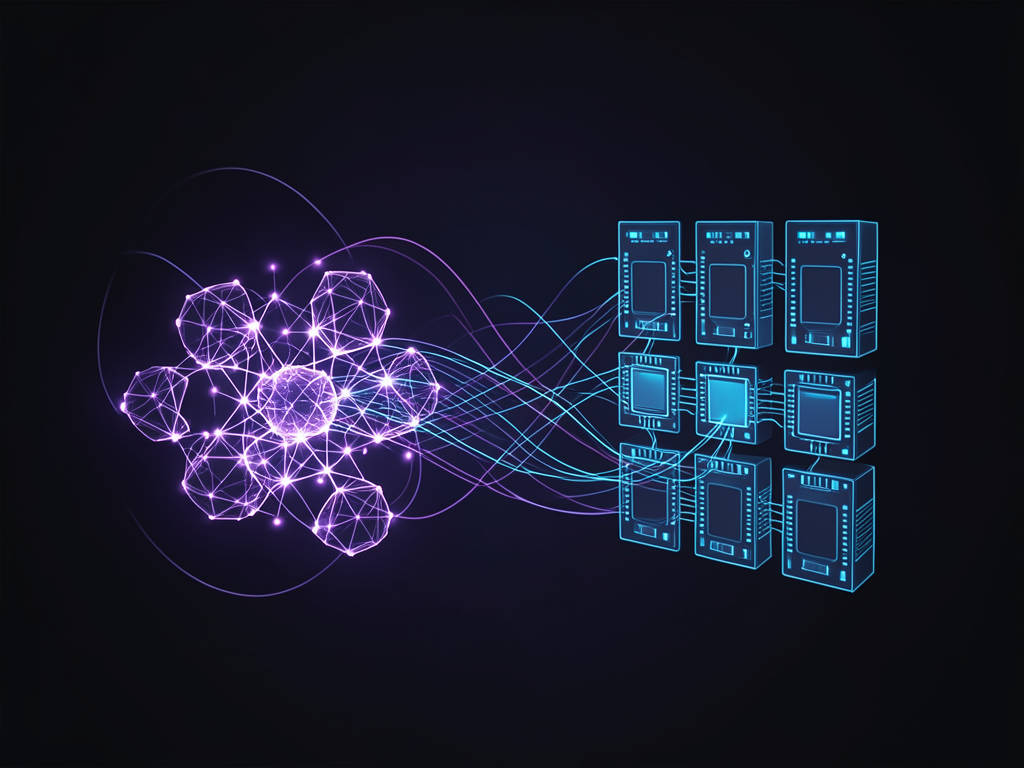
The architecture describes three hardware tiers. At the core sits the quantum system—QPUs paired with specialized classical runtime (FPGAs, ASICs, CPUs) for error correction and qubit calibration. Co-located scale-up systems (CPUs and GPUs) connect via low-latency RDMA or Ultra Ethernet for intensive error mitigation tasks. Partner scale-out systems (cloud or on-premises clusters) handle pre-processing, post-processing, and hybrid workflow components via high-bandwidth interconnects.
On the software side, IBM’s approach uses open interfaces rather than proprietary stacks. The Quantum Resource Management Interface (QRMI) exposes quantum resources to standard HPC schedulers like Slurm via SPANK plugins. Qiskit handles circuit optimization and preparation. Classical parallel processing uses familiar tools: MPI, OpenMP, SHMEM. Computational scientists can pull quantum into existing workflows through standard orchestration layers.
Real Science, Not Benchmarks
Several research groups have used this architecture to produce chemistry results:
Cleveland Clinic simulated the 303-atom Trp-cage miniprotein—one of the largest molecular models run on quantum-centric systems. The workflow used sample-based quantum diagonalization (SQD) integrated with fragment-based embedding methods. Results matched coupled-cluster methods like CCSD, demonstrating that hybrid quantum-classical approaches can handle scientifically meaningful systems.
IBM, RIKEN, and University of Chicago constructed ground state energy problems designed to test SQD convergence. When run on an IBM Quantum Heron processor, SKQD successfully converged to ground states where selected configuration interaction (SCI)—a leading classical method—failed. The test problems are synthetic, not real molecules, but they prove existence of specific use cases where quantum-centric approaches outperform classical-only methods.
RIKEN and IBM achieved large-scale quantum simulations of iron-sulfur clusters using closed-loop data exchange between RIKEN’s Fugaku supercomputer (all 152,064 classical compute nodes) and a co-located IBM Quantum Heron processor. This tight integration enabled electronic structure calculations beyond full configuration interaction capabilities.
Multi-university collaboration (IBM, Oxford, Manchester, ETH Zurich, EPFL, Regensburg) created a half-Möbius molecule—a carbon ring with electronic structure formed via a half-twist. They used SqDRIFT, an SQD-based algorithm, to predict properties and verified results with atomic force microscopy and scanning tunneling microscopy.
What This Means for HPC Centers
The architecture shows how quantum fits into five use case categories, each with different orchestration requirements:
- Algorithms like SKQD require scale-out systems and closed loops (temporal and spatial coupling considerations)
- Error mitigation needs high-throughput CPU and GPU resources
- Error correction experiments benefit from low-latency classical systems more closely integrated with QPUs
- Pre/post-processing workflows run on standard scale-out infrastructure
- Hybrid quantum-classical loops demand coordinated workflow management across all tiers
HPC centers can start with loosely coupled integration (quantum as a remote co-processor via cloud API) and evolve toward tightly integrated systems as applications mature. The reference architecture accommodates both approaches through modular design.
Limitations and Timeline
These results demonstrate pre-fault-tolerant quantum computers producing useful chemistry calculations, but within narrow constraints. The test problems where quantum outperforms classical are carefully selected—not arbitrary molecules. Fragment-based methods limit which systems can be studied. Error mitigation adds computational overhead that grows with circuit complexity.
IBM’s approach targets “simulating quantum with quantum”—chemistry and materials problems where quantum mechanics governs behavior. The architecture doesn’t claim quantum advantage for optimization, machine learning, or other application domains where classical methods remain dominant.
For computational scientists: if you work on chemistry simulations that strain methods like CCSD or DMRG, this architecture provides a roadmap for adding quantum to your toolkit. Timeline for production use depends on your specific problem—some chemistry calculations are delivering value now; broader applicability requires continued hardware and algorithm development.
Industry Context: Two More Integrations
Xanadu and AMD demonstrated aerospace simulations in hybrid quantum-classical environments using PennyLane quantum software with AMD HPC solutions on AMD DevCloud. The work shows how quantum compilation and simulation can optimize for engineering workloads. Christian Weedbrook, Xanadu CEO, positioned this as preparation: “helping ensure the aerospace industry is ready to adopt fault-tolerant quantum computing as soon as it becomes available.”
Quantum Computing Inc and Ciena jointly demonstrated quantum secure communication at OFC 2026, combining quantum key distribution, quantum authentication, and post-quantum cryptography in real-world network conditions. The demo addresses cybersecurity risks from future quantum computers breaking current encryption. For investors: this moves Quantum Computing Inc from lab demonstrations to tests with commercial network infrastructure, though pilot-to-revenue timelines remain uncertain.
What to Do Now
For HPC center administrators: Review the reference architecture paper and IBM’s technical implementation details. Identify whether your workloads include chemistry simulations that could benefit from quantum acceleration. Evaluate integration paths: cloud access first, co-located systems as demand grows.
For computational scientists: If you use FCI, CCSD, DMRG, or other quantum chemistry methods, consider testing hybrid workflows on IBM Quantum systems. Start with fragment-based problems where quantum can handle challenging subsystems. Build familiarity with Qiskit and quantum circuit concepts.
For CTOs evaluating quantum: This architecture represents practical integration, not speculative futures. Chemistry and materials organizations should assess candidate problems, build quantum literacy in computational teams, and establish relationships with quantum providers. Timeline: 1-3 years for pilot deployments, 3-5 years for production workflows in specialized domains.
The Feynman vision—simulating quantum systems with quantum computers—is starting to work for specific chemistry problems. IBM’s reference architecture shows how to plug that capability into existing infrastructure when your workload justifies it.
Sources & Further Reading
Primary sources:
- IBM Quantum-Centric Supercomputing Reference Architecture - full technical specification
- IBM Quantum Blog: Realizing Feynman’s Vision - overview and context
- IBM Research Blog: Technical Implementation - system architecture details
- Cleveland Clinic Trp-cage Study - 303-atom protein simulation
- SKQD Convergence Research - quantum vs classical comparison
- Half-Möbius Molecule Paper - experimental chemistry validation
Integration examples:
- Xanadu-AMD Partnership Announcement - aerospace simulations
- Quantum Computing Inc-Ciena Demo - quantum secure networking at OFC 2026
Context:
- RIKEN-Fugaku Integration - Japan’s tightly coupled supercomputer-quantum system
- Quantum Resource Management Interface - open standard for HPC-quantum integration